
Segmentation in Analytics: Why Averages Hide What Matters

Updated: Apr 14

Table of Contents
Most analytics dashboards look convincing. Metrics are neatly aggregated, trends appear stable, and averages create a sense of clarity. Teams rely on these numbers to make decisions, assuming they reflect how users behave. But this clarity is often misleading.
The fundamental problem is simple: the “average user” does not exist. What appears as a single behavioral pattern is usually a blend of very different user journeys. Some users are deeply engaged, others drop off immediately, and many sit somewhere in between. When combined, these behaviors produce an average that represents no one accurately.
Segmentation exists to break this illusion. It replaces surface-level summaries with structured understanding, allowing you to see how different groups of users actually experience your product.
Why Averages Hide More Than They Reveal
Averages are designed to simplify complexity, but in product analytics, that simplification often removes what matters most. They compress variation into a single number, masking the extremes that drive outcomes.
Consider a retention rate of 40%. At face value, it may seem acceptable. But this number could be hiding two very different realities: a segment of highly retained users and another that churns almost instantly. These are not minor variations they are fundamentally different behaviors requiring different solutions.
This creates what can be described as false clarity. Teams see stable metrics and assume stability in user behavior, when in reality, the system is fragmented. Decisions based on such averages tend to optimize for a middle ground that doesn’t truly exist, leading to incremental improvements at best and misguided changes at worst.
What Segmentation in Analytics Actually Means
Segmentation is often misunderstood as a simple grouping exercise, but its real purpose is deeper. It is a method of separating users based on meaningful differences in behavior and intent, so patterns become interpretable.
At a practical level, segmentation helps answer questions that averages cannot:
Question | Without Segmentation | With Segmentation |
Why is retention dropping? | Unclear trend | Specific segments are churning |
Why is conversion low? | Funnel drop-off | Certain users never reach intent stage |
Why is engagement inconsistent? | Fluctuating metrics | Different usage patterns across segments |
This shift transforms analytics from descriptive reporting into explanatory insight. Instead of asking what happened, segmentation helps uncover why it happened and for whom.
The Shift from Demographics to Behavior
Traditional segmentation relies heavily on demographics such as age, gender, or location. While useful in marketing contexts, these attributes rarely explain how users behave inside a product.
Two users with identical demographic profiles can exhibit completely different interaction patterns. One might explore features deeply and complete key actions, while the other struggles to navigate the interface and exits early. The difference lies not in who they are, but in what they do.
Behavioral segmentation focuses on observable actions. It captures how users interact, how frequently they return, and how deeply they engage. This makes it a far more reliable proxy for intent.
Some of the most useful behavioral signals include:
Actions completed (e.g., transactions, feature usage)
Frequency and recency of sessions
Depth of interaction within key flows
Sequence of actions leading to outcomes
Behavior provides a dynamic view of users, allowing segmentation to evolve as user intent changes over time.

Core User Segments That Reveal Real Insights
While segmentation can be applied in many ways, certain user distinctions consistently reveal meaningful patterns across products. These segments act as foundational lenses through which behavior becomes clearer.
New vs Returning Users
New users operate in a state of uncertainty. They are evaluating value, trying to understand the interface, and deciding whether the product is worth their time. Their experience is shaped by onboarding, clarity, and initial friction.
Returning users, in contrast, have already formed an opinion. Their behavior reflects ongoing value rather than discovery. When these two groups are analyzed together, critical insights are lost. A drop in engagement may appear as a product issue, when it is actually an onboarding failure affecting only new users.
Power Users vs Casual Users
Power users are often mistaken for simply being more active, but their defining characteristic is depth, not just frequency. They engage with core features, complete meaningful actions, and consistently derive value from the product.
Casual users tend to interact at a surface level. They may open the app occasionally, explore limited functionality, and leave without forming strong habits. When averaged together, these behaviors dilute each other, making it difficult to understand what drives real engagement.
Power users show you where value exists. Casual users show you where it fails to materialize.

High-Intent vs Low-Intent Users
Intent is one of the most critical dimensions in segmentation, yet it is often overlooked. Some users enter a product with a clear goal, while others are exploring without a defined objective.
High-intent users move quickly and expect efficiency. They are sensitive to friction and will abandon flows that delay their progress. Low-intent users require guidance, context, and discovery to move forward.
Without segmentation, these behaviors blend together, resulting in experiences that serve neither group effectively.
Segmentation Reveals What Funnels Cannot
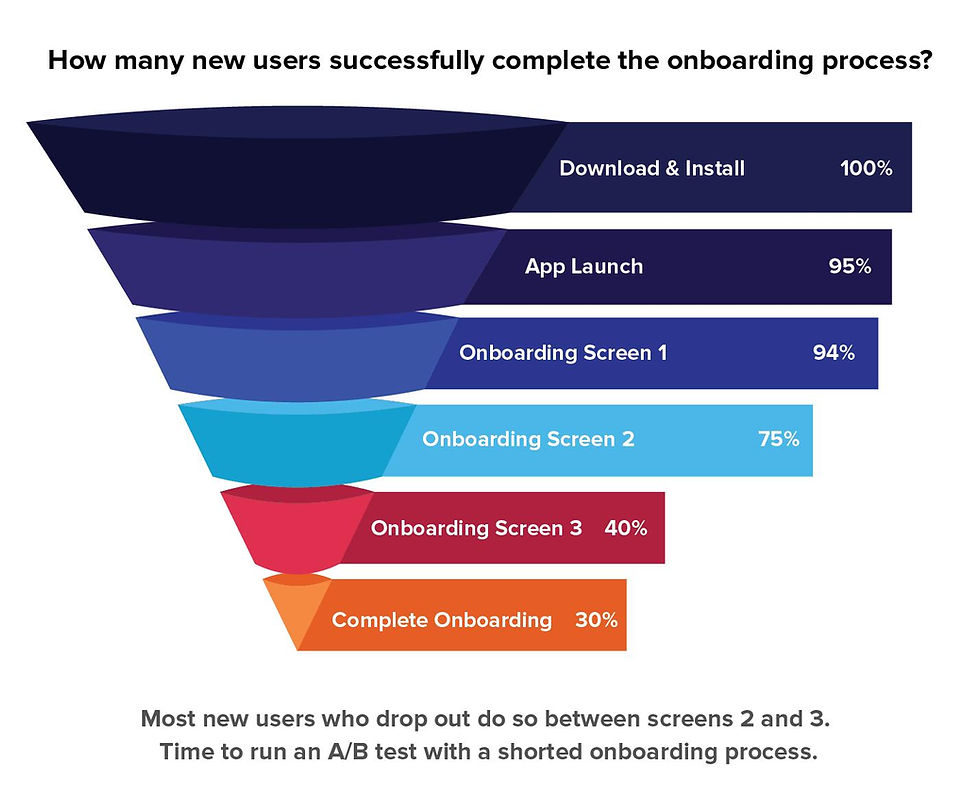
Funnels are widely used to track user journeys, but they are inherently limited. They show where users drop off, but not why those drop-offs occur.
Segmentation adds the missing dimension of context. When funnels are broken down by user segments, patterns emerge that are otherwise invisible. The same drop-off point can represent entirely different issues depending on the segment.
For example, new users may drop off due to confusion or lack of clarity, while returning users may drop off due to diminished value or unmet expectations. Treating these as a single problem leads to ineffective solutions.
Segmentation transforms funnels from static diagrams into diagnostic tools.
Using Segmentation to Improve Retention
Retention is often approached as a single metric, but it is better understood as a collection of behaviors across different user groups. Each segment has its own retention curve, influenced by distinct factors.
Cohort-based segmentation allows you to analyze retention based on when users joined and what they did early in their journey. This reveals patterns that averages conceal.
For instance, users who complete a key action in their first session may retain significantly better than those who do not. This insight shifts the focus from generic retention strategies to targeted interventions.
Instead of asking why retention is low, segmentation reframes the problem:
Which users are not retaining, and what did they experience differently?
Using Segmentation to Redesign Onboarding
Onboarding is often treated as a universal flow, designed to guide all users through the same sequence of steps. This assumes that all users have similar goals, which is rarely true in practice.
Segmentation allows onboarding to adapt to user intent. High-intent users benefit from direct paths to core actions, while exploratory users need more guidance and context. Returning users may not need onboarding at all and can be routed directly to value.
When onboarding is aligned with user segments, friction is reduced and time-to-value improves. This not only increases conversion but also sets the foundation for long-term retention.
From Insight to Action: Making Segmentation Useful
One of the most common pitfalls in analytics is stopping at insight. Teams create segments, identify patterns, and build dashboards but fail to translate these findings into product decisions.
Segmentation becomes valuable only when it influences action. This requires prioritization and clarity.
A practical approach involves focusing on segments that have the highest impact on key outcomes. Instead of analyzing every possible group, concentrate on those that directly affect retention, conversion, or engagement.
Step | Focus | Outcome |
Define objective | Retention, onboarding, or conversion | Clear direction |
Identify behaviors | Actions tied to value | Relevant segmentation |
Compare segments | Analyze differences | Insight generation |
Implement changes | Adjust product experience | Measurable impact |
The goal is not to increase analytical complexity, but to improve decision quality.

Common Pitfalls That Reduce the Value of Segmentation
Segmentation is powerful, but it can fail when applied without discipline. One of the most common issues is over-segmentation, where too many categories are created without a clear purpose. This leads to fragmented insights and decision paralysis.
Another challenge is relying on static segments in dynamic environments. User behavior evolves over time, and segmentation models must reflect these changes. A user who was once new becomes experienced, and their needs shift accordingly.
There is also the risk of misinterpreting correlations as causation. Just because a segment behaves differently does not mean that behavior is the cause of an outcome. Careful analysis is required to avoid misleading conclusions.
Beyond Basic Segmentation: Advanced Applications
As products grow more complex, segmentation can evolve into more sophisticated forms. These include:
Lifecycle segmentation, which tracks users across stages such as onboarding, activation, and retention
Predictive segmentation, where machine learning identifies users likely to churn or convert
Real-time segmentation, enabling dynamic personalization within the product experience
These approaches extend segmentation from analysis into active product shaping, where experiences are tailored in response to user behavior.
Conclusion: There Is No Average User, Only Missed Context
The idea of the average user is appealing because it simplifies analysis. But this simplicity comes at a cost. It hides variation, masks intent, and leads to decisions that fail to address real user needs.
Segmentation restores that missing context. It reveals that behavior is not uniform, that users experience products differently, and that meaningful insights lie in those differences.
When analytics moves beyond averages, it becomes more than a reporting tool. It becomes a system for understanding, diagnosing, and improving how products work.
And that shift from summary to insight is where real product progress begins.
FAQs
What is segmentation in analytics?
Segmentation in analytics is the process of dividing users into groups based on shared behaviors, characteristics, or actions to better understand how different users interact with a product.
Why are averages misleading in product analytics?
Averages combine multiple user behaviors into a single value, which hides important differences between user groups and makes it difficult to identify specific issues or opportunities.
What is behavioral segmentation?
Behavioral segmentation groups users based on their actions within a product, such as feature usage, session frequency, and interaction patterns, to better understand user intent.
How does segmentation improve retention?
Segmentation helps identify which user groups are dropping off and why, allowing teams to address specific issues and improve retention through targeted changes.
What are common mistakes in segmentation?
Common mistakes include over-segmentation, relying on static user groups, and misinterpreting correlations as causation, all of which can lead to misleading insights.


Comments